
Walking as Infrastructure: The City That Forgot Its Feet
Why Lucknow's pedestrian infrastructure fails, what Chennai's NMT policy proves, and five first moves to make the city walkable. Fixing Lucknow essay 01 by Ar. Shikhar Singh.
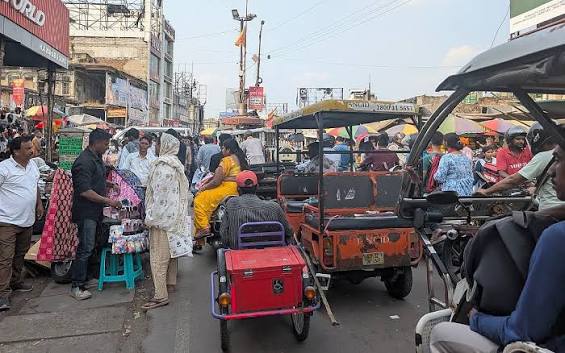
Walk from Hazratganj to the Vidhan Sabha. It is barely a kilometre, which in Lucknow terms means fifteen minutes on foot or forty by car, depending on which wedding season it is.
Try it at 2 pm in June. Try it at 8 pm as a woman. Try it any day pushing your father's wheelchair. You will learn everything about how our city thinks of people who move without engines, which is to say, you will learn that the city has not thought about them at all.
The footpath appears and disappears like a rumour. Where it exists, it is parked on, dug up, hosting a transformer, or ends mid-stride at a drain with the quiet confidence of a sentence that never......
We laugh about it, because the alternative is to count. But somewhere between the third parked SUV and the fourth missing slab, a question worth sitting with appears: a footpath is the only piece of infrastructure a citizen uses from age two to age ninety two. Why is it the one we never got around to building?
THE MAJORITY NOBODY COUNTS
Here is the joke the spreadsheet plays on us. A very large share of daily trips in Indian cities are already made on foot. The pedestrian is the majority stakeholder of the street. We simply treat him as an encroacher on his own property, like a landlord evicted by his tenant, and a two-wheeler parked where his kitchen used to be.
The consequences are not funny at all, which is rather the point of the joke. Analyses of road crash data by ITDP India found that in cities like Chennai and Coimbatore, pedestrians account for 30 to 50 percent of all road crash fatalities. Nobody has published the equivalent number for Lucknow, and one suspects this is not because the number is flattering. The same research found that a school-going child meets roughly ten obstructions every hundred metres of footpath. Ten. Per hundred metres. We have converted walking to school into an obstacle sport, minus the medals.
And the failure is not distributed equally, because failures never are. The able-bodied man on a two-wheeler barely registers it; he has already annexed the footpath as a fast lane. The tax falls on the elderly, on children, on the woman calculating at dusk whether that dark stretch is worth the shortcut, on the vendor whose livelihood is the street's edge, on the person for whom one broken slab is not an inconvenience but a wall. A city reveals its philosophy not in its monuments but in its kerbs. Ours says: you are welcome here in proportion to your horsepower.
WHAT GOOD PRACTICE LOOKS LIKE (SPOILER: IT IS IN CHENNAI, NOT COPENHAGEN)
The convenient defence of the status quo is that walkable cities are a European luxury, unaffordable in our climate and chaos. It is a comforting theory, ruined only by Chennai.
In 2014 Chennai became the first Indian city to adopt a Non-Motorised Transport Policy. It did two radical things. First, it stated a priority out loud: pedestrians, cyclists and public transport come before private motor vehicles in street design. Second, and this is the part that separates policy from poetry, it attached money: a minimum of 60 percent of the transport budget mandated for building and maintaining walking and cycling infrastructure. Chennai has since redesigned well over a hundred kilometres of streets, rationalised its carriageways, organised its parking, and turned the chaos of Pondy Bazaar into a pedestrian plaza that shopkeepers first protested and now defend like ancestral property. Cities from Chandigarh to Nairobi have copied the homework.
Notice what Chennai did not do. It did not wait for one more flyover to finally cure congestion, a treatment we have been prescribing ourselves for forty years with the success rate of a lottery ticket. It simply decided whom the street was for, and then let the budget repeat the decision every year.
If you want the international proof anyway, skip Copenhagen and look at Pontevedra, a small Spanish city about the size of our old core, which progressively freed its centre of through traffic. Walking became the default mode, and road deaths in the calmed core fell to nearly zero. Nearly zero is a strange number to our ears. We budget for fatalities the way we budget for monsoon potholes: as weather.
FIVE FIRST MOVES FOR LUCKNOW
1. Adopt an NMT policy with a budget percentage attached. Words without money are decoration, and our cities are already sufficiently decorated. Even 30 percent would transform Lucknow in five years.
2. Pick three demonstration corridors, not thirty announcements. Hazratganj to Charbagh. One school cluster in Gomti Nagar. One old-city bazaar street. Continuous footpath, shade, organised vending, crossings that do not require prayer. Let people feel the difference; the demand will do the scaling.
3. Write a Lucknow Street Design Manual and make it binding on LDA, Nagar Nigam, PWD and the Smart City SPV alike. The two-lane-to-six-lane lottery exists because five agencies design one street and none of them has met the others.
4. Design vending in, not out. The Street Vendors Act already requires vending zones. A designed vending edge is the cheapest streetlight, the cheapest CCTV and the cheapest crowd a footpath can have. The chaiwala is not the obstruction; he is frequently the only reason the street is safe.
5. Audit every corridor with the least powerful user, not for them. If the street works for an eight-year-old and an eighty-year-old, it works for everyone. If it only works for a Scorpio, it is not a street; it is a runway with shops.
THE ARGUMENT UNDERNEATH
At a+ud we make a version of this argument at building scale every week: design that respects climate and human use costs less over its life than design that imports an image. Streets obey the same law. A city that cannot deliver a continuous footpath is not poor; Lucknow builds flyovers the way some families buy sofas, for the guests. It is not short of money. It is short of a decision about who the city is for.
And here is the thought to carry to your evening walk, if you can find a footpath to have it on. Lucknow already knew all of this. Chowk and Aminabad are among the finest walking environments north India ever produced: shaded, dense, mixed, humane, built by people who never heard the word walkability because they could not imagine a city that needed it. The knowledge is in the city's bones. We did not lose it. We overruled it.
Next week: the mystery of the six-lane road that becomes two lanes without notice, and what a road hierarchy is actually for, besides press releases.
This is the first essay in Fixing Lucknow, a weekly series on the urban design of our city and, by extension, of India's tier-2 cities. Disagreement is welcome; that is what the series is for. Write to mail@aplusud.in.
References: ITDP Chennai NMT Policy case study (nmttoolkit.itdp.org); ITDP India road crash and footpath obstruction analyses (itdp.in); Greater Chennai Corporation NMT Policy 2014; ITDP and Ashden, Chennai Streets for People award citation; Pondy Bazaar Pedestrian Plaza, Chennai Street Design Project; Pontevedra pedestrianisation, municipal reports; Street Vendors (Protection of Livelihood and Regulation of Street Vending) Act, 2014.
follow us on Instagram : www.instagram.com/aplusud
source : How India moves: With vehicle numbers spiking by 10-12% every year, Lucknow is hurtling towards a mobility crisis (https://www.downtoearth.org.in/air/how-india-moves-with-vehicle-numbers-spiking-by-10-12-every-year-lucknow-is-hurtling-towards-a-mobility-crisis)
Address
B1-430, DLF My Pad, Vibhuti Khand, Lucknow India-226010
Contacts
+91 9696594948
mail@aplusud.in
Quick Links
All Rights Reserved | 2026-27 | A+UD | Page last updated: July 2026